Many Hands Behind One Handbook: A Year of CEOS–GEO Collaboration
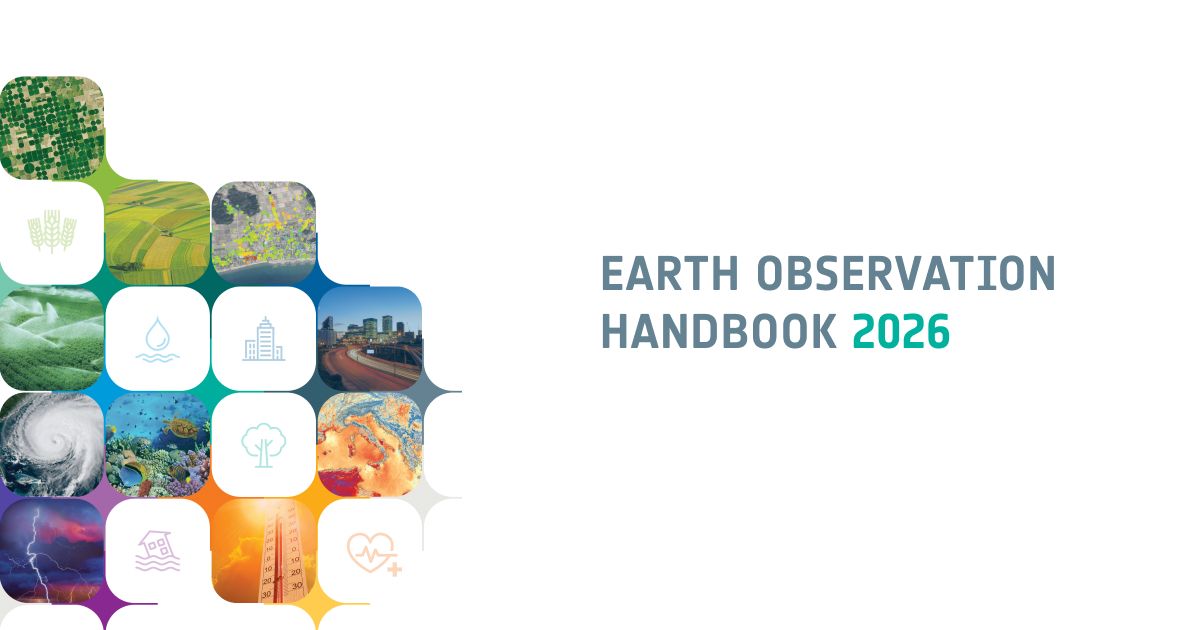
The 2026 CEOS Earth Observation Handbook on Adaptation and Resilience has many hands behind it, and that is what makes this edition very special to us. Over the past year, the Committee on Earth Observation Satellites (CEOS) and the GEO Secretariat have worked closely to bring together practical experiences from satellite agencies, GEO Work Programme activities and the wider GEO community, showing how satellite-based Earth observations are making a difference in adaptation decisions.
Published every few years, the new Handbook was launched on 3 November 2026 at the CEOS Plenary in Hobart, Tasmania. Sponsored by the European Space Agency (ESA), it supports the 2026 CEOS Chair's priority on adaptation and resilience.
We are delighted to see four GEO Work Programme activities featured in the Handbook, alongside eight additional contributions from the wider GEO community. They cover a wide range of adaptation challenges, from food security and forest monitoring to disaster response, public health and infrastructure.
GEO Work Programme activities
Wider GEO community responded to the call
Building on a partnership of more than 20 years
CEOS holds an important place in GEO's history. As one of its founding Participating Organisations, CEOS helped bring GEO into being more than 20 years ago and has since served as its "space arm", connecting satellite agencies and their capabilities with the broader GEO community. Many GEO Work Programme activities are supported by CEOS and its member space agencies, contributing satellite data, scientific expertise and technical capabilities.
For this Handbook, we wanted to build on these established partnerships while reaching further into the wider GEO community to capture diverse applications and experiences.
We began with a joint call for expressions of interest in December 2025, inviting the GEO community to share their experiences. Over the following months, we worked closely with contributors, with Stephen Ward and Matthew Steventon on the CEOS Handbook team and Rui Kotani coordinating the GEO contributions from the Secretariat. Together, we helped turn initial proposals into developed case studies and considered how they would fit into the broader selection, with attention to geographic balance and coverage across six adaptation areas. The resulting online atlas brings together 44 case studies from around the world.
The GEOGLAM case study in Malawi, which was coordinated by Sven Gilliams and Stephen Ward, and supported by FAO and NASA harvest, helped guide further submissions from the CEOS community. Following the 2024 El Niño, which damaged nearly one million hectares of crops and reduced yields by 23%, NASA Harvest (GEOGLAM), working with FAO, applied Global EO for Crop Inventory Forecasting, a machine learning model combining satellite observations and climate data, to forecast crop yields two to three months before harvest. These early forecasts support government agricultural assessments and offer valuable lead time for drought preparedness and food security decisions, with expansion to Mozambique planned.
Rui also connected the CEOS Handbook team with Kamal Kishore, Special Representative of the UN Secretary-General for Disaster Risk Reduction and Head of UNDRR, facilitating his contribution of a foreword highlighting the importance of Earth observations for strengthening resilience.
The power of collaboration
One of the most rewarding aspects of this process has been seeing people from different organisations come together, each bringing their expertise and experience. It is a reminder that making satellite observations useful for decision-makers takes much more than the data themselves.
The Handbook will be featured during COP31, including during the joint GEO and CEOS/CGMS presentation delivered by JAXA at Earth Information Day on 9 November (15:00-18:00) and the ESA-led side event on Earth observations and climate action later that day (18:30–20:00).
We hope the Handbook will inspire more people to learn from these experiences, build new partnerships and make greater use of satellite information in their own adaptation decisions.