Earth Intelligence for Humanitarian Action: Notes from Humanitarian Networks and Partnerships Weeks
When a humanitarian crisis unfolds, does Earth Intelligence reach decision-makers in time?
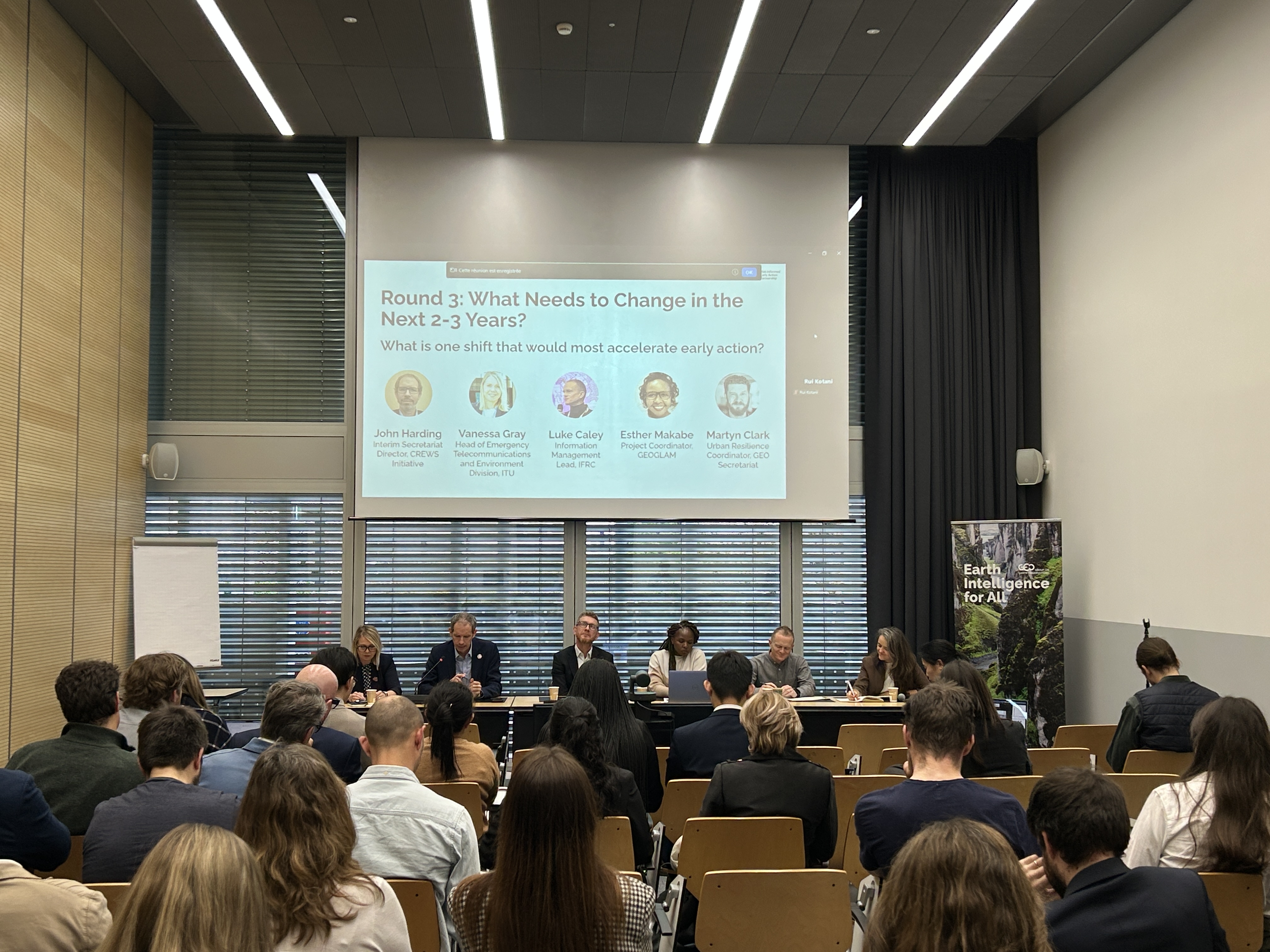
That was the question at the heart of a joint session organised by GEO and the Risk-informed Early Action Partnership (REAP) at Humanitarian Networks and Partnerships Weeks (HNPW) in Geneva on 10 March.
More than 70 participants joined in person and online to explore how Earth observation data can be transformed into actionable intelligence for early warning, crisis response and recovery.
The verdict from the expert panel was that barriers are no longer technological. The challenges are institutional and operational, rooted in trust, coordination, usability and the integration of insights into real-world decision-making processes.
After opening remarks from GEO Secretariat Director Yana Gevorgyan and a video message from Ronald Jackson, panellists John Harding, Luke Caley, Vanessa Gray, Esther Makabe and Martyn Clark identified a number of recurring friction points:
Lack of systematic ground-truthing and validation.
- Information noise during crises caused by competing analyses.
- Institutional fragmentation and siloed mandates.
- Insufficient co-development of services with users.
- Gaps in last-mile warning dissemination.
As Makabe put it, "We should stop baking cakes for people who won't eat them."
Key collaborations lead to early success
The session highlighted emerging collaboration between GEO and the International Telecommunication Union (ITU) under the Early Warnings for All (EW4All) AI subgroup, where partners explore how Earth observation data, telecommunications information, and AI can be combined to strengthen early warning systems.
In particular, emerging collaboration between ITU and GEO’s Global Heat Resilience Service shows how ongoing initiatives can be aligned to support decision-making while avoiding duplication.
GEO Global Agricultural Monitoring was highlighted as an example of a consensus-based product that increases trust and reduces information overload. Also showcased were Earth Observations for Disaster Risk Management, Geohazard Supersites and Natural Laboratories, Human Planet Initiative and GEO Land Degradation Neutrality.
The session demonstrated that Earth Intelligence is becoming an essential component of humanitarian decision-making. But realising its full potential will require stronger partnerships, transparency in analytical processes, and sustained collaboration with the users who rely on these insights.
As moderator Catalina Jaime concluded, the challenge ahead is to ensure the right information reaches the right people at the right time.
Watch the full session recording below or download the outcomes report from HNPW.
Read also: the next blog in our GEO youth CoP blog series from Sabrina Wong, who has written about her experience supporting GEO’s efforts at HNPW.