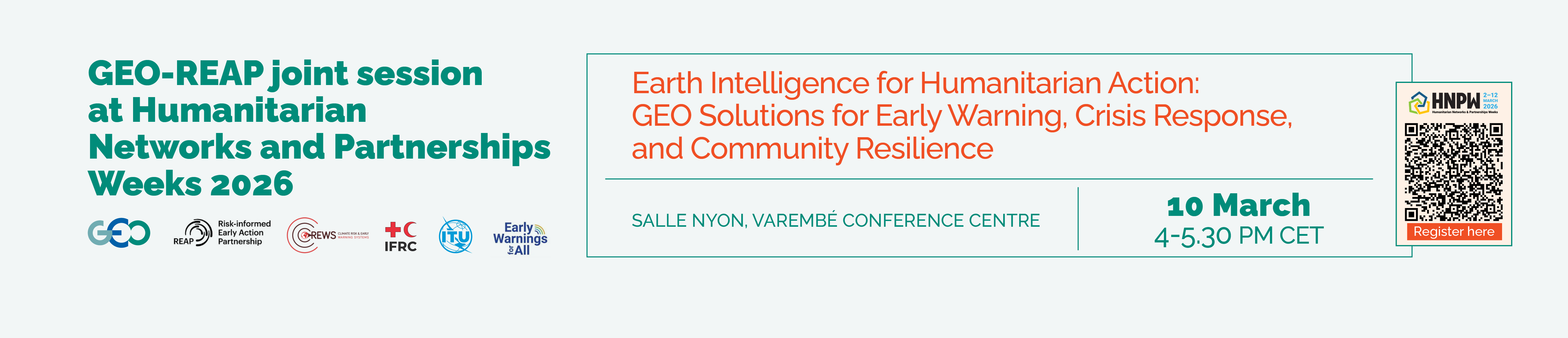
GEO-REAP joint session at Humanitarian Networks and Partnerships Weeks 2026
At Humanitarian Networks and Partnerships Weeks (HNPW) 2026, GEO in collaboration with the Risk-informed Early Action Partnership (REAP) organised the session: Earth Intelligence for Humanitarian Action: GEO Solutions for Early Warning, Crisis Response, and Community Resilience.
The event showcased how Earth observations and Earth Intelligence solutions from across the GEO Work Programme directly support humanitarian and early action decision-making, including within global initiatives such as Early Warnings for All (EW4All).
Through a moderated panel, expert speakers explored which decisions are already supported by Earth observation, where bottlenecks remain, and what needs to change over the next two to three years to accelerate impact.
Programme
16:00–16:05
Welcome and introduction
GEO Secretariat Director Yana Gevorgyan challenged participants to consider whether Earth Intelligence is truly reaching decision-makers when and where it counts, contextualised against the backdrop of the humanitarian crisis unfolding in the Middle East.
16:05–16:12
Opening context: Earth observations for humanitarian decision-making
Ronald Jackson, Head of DRR at UNDP (in recorded video), as an applied Earth observation user or partner organisation, provided a short framing input, highlighting how Earth observation and Earth Intelligence support humanitarian action, anticipatory action, early warning, crisis mapping, post disaster needs assessment and other critical humanitarian functions.
16:12–16:50
Expert panel discussion
Moderator opened with one framing question, followed by 3 thematic rounds of discussions (10 min each):
- What decisions does EO already support today?
- What prevents EO from being used earlier or at scale?
- What needs to change in the next 2–3 years?
Moderator: Catalina Jaime, Head of REAP Secretariat
Panelists:
- John Harding, Interim Secretariat Director, the Climate Risk and Early Warning Systems (CREWS) initiativet
- Luke Caley, Information Management Lead at the International Federation of Red Cross and Red Crescent Societies (IFRC)
- Vanessa Gray, Head, Emergency Telecommunications and Environment Division, BDT, ITU
- Ester Makabe, Project Coordinator, GEO Global Agriculture Monitoring (GEOGLAM)
- Martyn Clark, Urban Coordinator, GEO Secretariat
16:50–17:10
Audience Q&A (hybrid)
The Q&A actively engaged both in-person and online participants.
17:10–17:20
GEO activity highlights: Tools and collaboration opportunities
A rapid series of 1-minute highlighted from relevant GEO Work Programme activities, focusing on access pathways, supported by QR codes to GEO tools and platforms.
- Esther Makabe: GEO Global Agricultural Monitoring (GEOGLAM) with the Crop Monitor for Early Warning, detecting emerging crop failures and food security hotspots through systematic monthly global monitoring.
- Martyn Clark: GEO Global Heat Resilience Service (GHRS) soon with prototypes of digital decision-support tools, mapping neighbourhood-level heat risk, identifying vulnerable populations, and guiding city heat-resilience actions.
- Andrew Eddy: Earth Observations for Disaster Risk Management (EO4DRM) with CEOS Recovery Observatory: using satellite data after disasters to support post-disaster needs assessments and recovery planning.
- Andrew Eddy: Geohazard Supersites and Natural Laboratories (GSNL) with geohazard monitoring support: integrating satellite and ground observations for earthquake and volcano risk decisions.
- Michele Melchiorri: Human Planet Initiative with the Global Human Settlement Layer (GHSL): providing global data on people, buildings and settlements to support disaster response, crisis analysis and development planning.
- Bernd Eversmann: GEO Land Degradation Neutrality (GEOLDN) with the LDN-Toolbox: a user-oriented entry point to plan towards Land Degradation Neutrality.
17:20–17:30
Concluding reflections and next steps
The moderator summarised discussion highlights and reflects on opportunities emerging from the session.