The GEO Indigenous Alliance and Seven Years of Building With the GEO Community
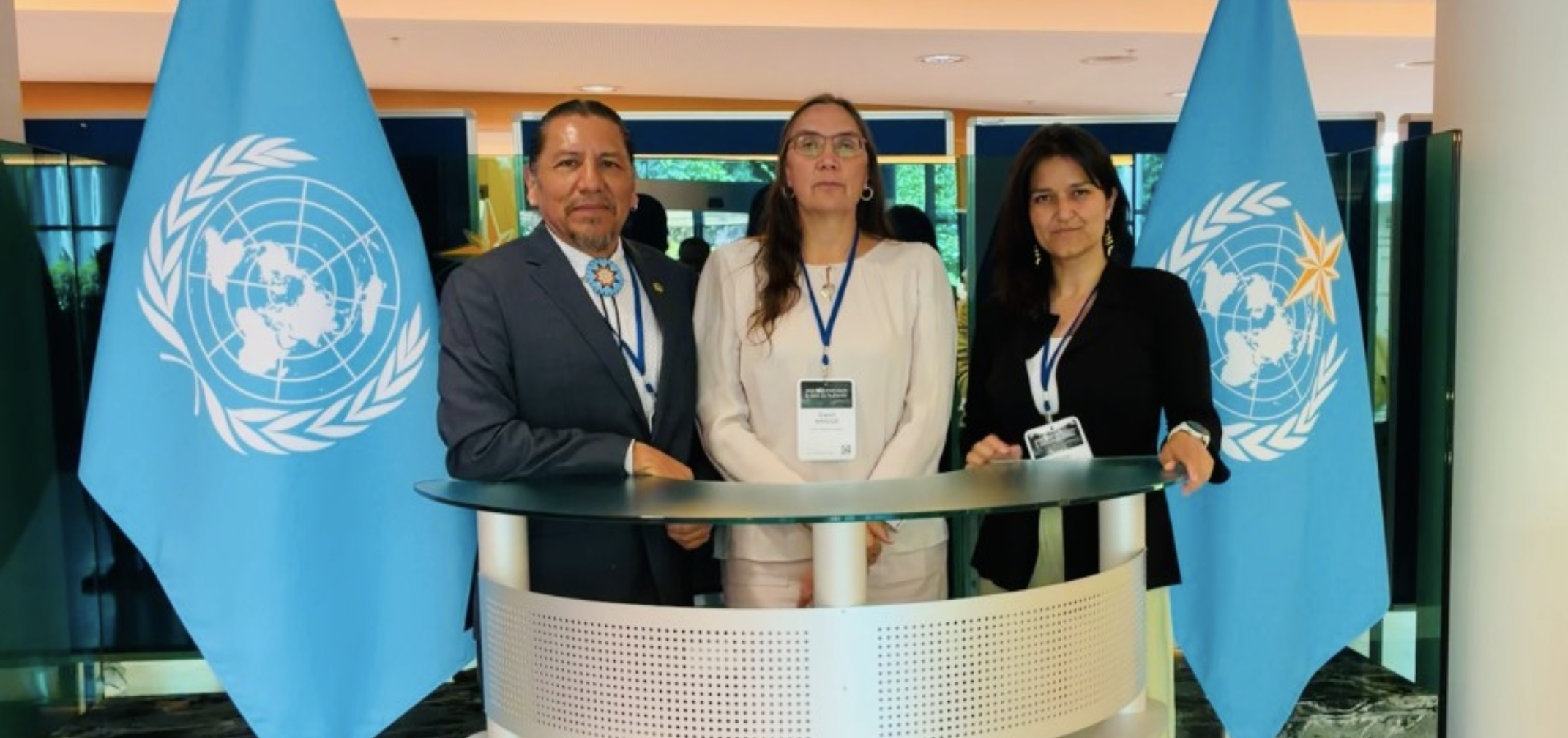
Seven years ago, Indigenous representatives from Africa, North and South America, and Australia founded the GEO Indigenous Alliance at the 2019 GEO Ministerial Summit. At the 2026 GEO Symposium and GEO-21 Plenary in Geneva, that founding moment showed what it has grown into: Geneva wasn't a launch, but proof of steady, collective work, and an open invitation to build the next stage with the GEO community.
Real conversations, real commitments
Our community event brought together James Rattling Leaf Sr. (Sicangu Lakota Oyate), Gwen Bridge (Saddle Lake Cree Nation), Paola De Salvo, and Diana Mastracci Sanchez around relational values as a working methodology: measuring biodiversity not only through data points, but through the relationships between people and land that data alone can't capture — the foundation for the Indigenous Essential Biodiversity Variables the Alliance is now developing. We asked the room where collaboration could matter most. People named mountains, forests, floods, wildfires, protected areas, universities, youth networks — and the conditions that make partnership real: Indigenous-led policy, stronger regional voice, fair access to tools, and no single model standing in for every Indigenous Peoples and territory.
That conversation is becoming infrastructure. We announced the creation of the GEO Indigenous Alliance Knowledge Hub, now being developed with the GEO Knowledge Hub team as a governed pathway through which selected methods, tools and knowledge resources can reach the GEO community with their context, authorship and accountability intact.
Putting ethics before the data
AI is moving fast into biodiversity monitoring: training on satellite imagery, camera traps, shaping what gets classified, protected, funded. Most of the field is racing for accuracy. The GEO Indigenous Alliance asked a harder question first: who builds it, whose knowledge trains it, who answers for what it decides, because what a system is taught to notice first shapes everything it will later see.
James presented the Toolkit itself, built with Space4Innovation and support from Environment and Climate Change Canada, grown out of Ltome-Katip, our two-year Indigenous-led bioacoustic project for responsible AI in biodiversity with Samburu and Shuar partners. The framework exists to walk researchers, funders, and developers through consent, accountability, and benefit-sharing before an AI system is designed, and that gap is exactly what the Toolkit fills. Already presented at the GEO Symposium, COP30, and — days after Geneva — the biodiversity forum in Davos, it's now open for community review through 30 September: geoindigenousalliance.org/aibiodiversitytoolkit.
At the youth session, Diana pointed to Ltome-Katip as proof that Indigenous-led AI already works: young Samburu and Shuar researchers building and training the systems themselves, not just using ones built elsewhere.
Geneva followed GEO Indigenous Summits in 2020, 2023, and March 2026. In seven years the Alliance has gone from a founding declaration to three summits, a working toolkit already presented on three continents, Indigenous-led hackathons, and a Knowledge Hub built to carry that work forward — among other things, including years of fieldwork that put Ltome-Katip at the forefront of responsible AI for biodiversity. What we're asking of the GEO community now is simple: keep building this with us. Institutions, like any instrument, are judged by what they make possible.