From Earth observations to healthier societies: One Health in action at AmeriGEO Week 2025
Environmental change, biodiversity loss and human health risks are increasingly connected. Responding to these complex challenges requires a One Health approach that recognises the deep links between ecosystems, animals and people, turning data into action.
At AmeriGEO Week 2025 in Bogotá, Colombia, a number of discussions explored how Earth observations can enhance health resilience throughout the Americas, from oceans and coasts to cities and river basins.
Marine biodiversity and Blue One Health in focus
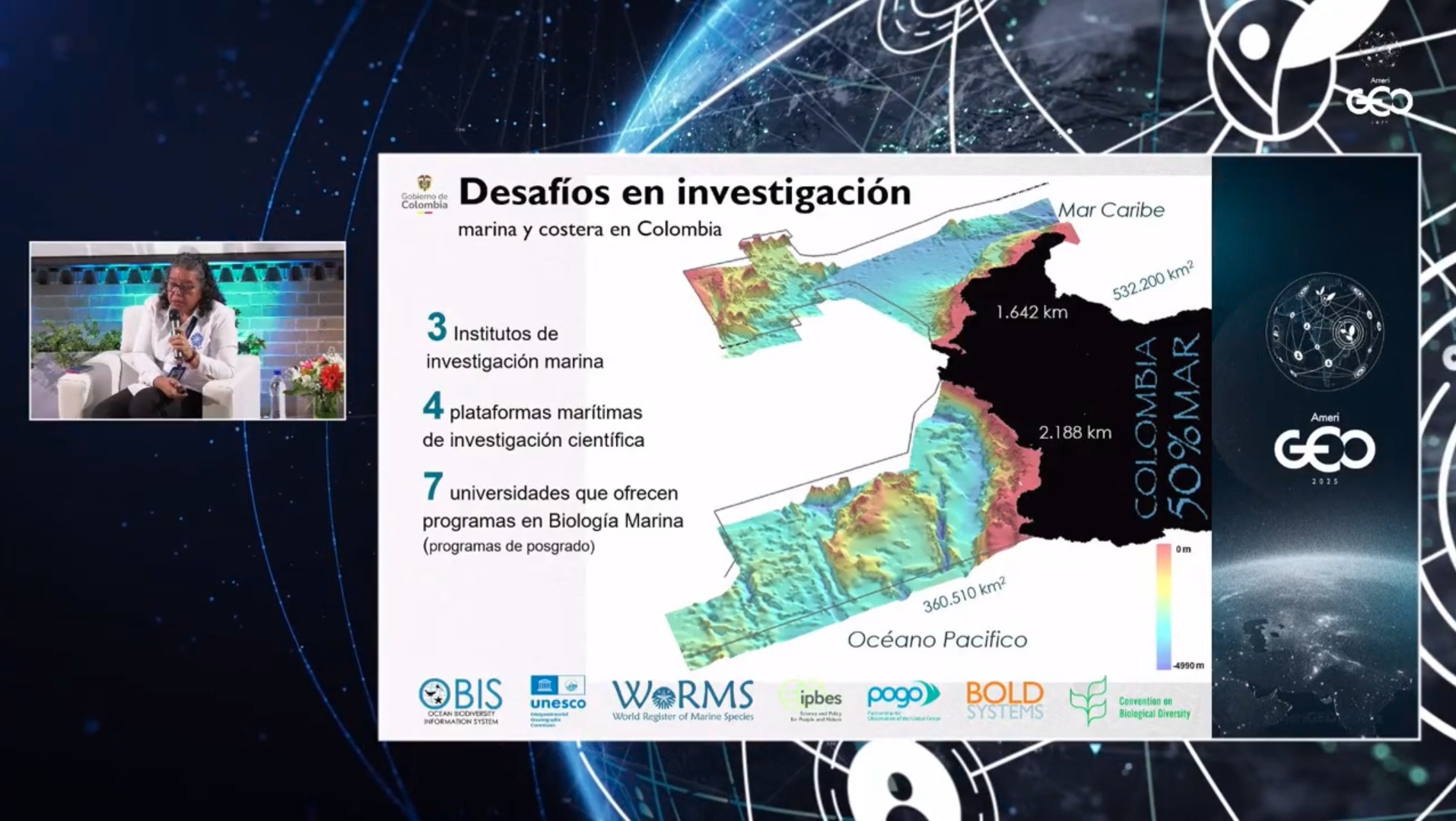
The session Marine Biodiversity and Blue One Health in the Americas: Advancing Health Resilience through Ecosystem Sustainability and Earth Intelligence (watch here: English/Spanish | learn more) focused on the aquatic ecosystem health dimension of One Health.
Panellists Martha Patricia Vides Casado from José Benito Vives de Andréis Marine and Coastal Research Institute, Edgardo Londoño-Cruz from Universidad del Valle, Sergio Mauricio Molano Cárdenas from the Federal University of Rio Grande do Sul, and Timothée Poisot from Université de Montréal emphasised that healthy marine ecosystems underpin food security, livelihoods, and coastal protection. They also made the point that disruption to marine biodiversity can lead to economic and public health impacts.
Leveraging Earth observations and advanced technologies is crucial for monitoring marine ecosystems, developing proactive solutions, and enabling early warning systems. This work employs a multidisciplinary approach that combines satellite imagery for assessing water quality with traditional methods and emerging tools, such as environmental DNA (eDNA) sampling and artificial intelligence.
The session highlighted that the main takeaway is the urgent need for sustained investment in marine science, data management, and local capacity, as well as stronger collaboration among governments, researchers, communities, and the private sector, to effectively strengthen the resilience of marine ecosystems and, by extension, human and planetary health.
Earth science as a backbone for One Health partnerships
Another session on Promoting Earth Science Applications to Enhance One Health Partnerships focused on how Earth observations can support environmental and public health decision-making.
Panellists Diego Moreno Heredia from the Ministerio de Salud y Protección Social, Mayra Vargas from the Ministerio de Ambiente y Desarrollo Sostenible, Rodrigo González Florian from the Secretaría Distrital de Ambiente de Bogotá, Hugo Mantilla Meluk from Universidad del Quindío and Gina Polo Infante from Pontificia Universidad Javeriana shared practical examples of how satellite data and other Earth observation tools are used to identify risks and guide interventions.
Remote sensing was highlighted as a powerful source of spatial and temporal information for detecting air pollution hotspots, tracking land-use change, and supporting the development of early warning systems. Integrating data with health surveillance can help experts anticipate disease outbreaks and target prevention measures.
Several examples illustrated this link, including mapping bird migration routes to provide insight into avian influenza dynamics and monitoring changes in habitats associated with rats, ticks, and mosquitoes to help understand patterns of diseases.
Local and Indigenous communities were recognised as critical partners, both in data collection and shaping prevention and response strategies grounded in local realities.
Shared challenges and shared solutions
Common themes emerged across these sessions, such as the importance of data interoperability, cross-sector collaboration, and local capacity. Participants repeatedly highlighted that technology alone is not enough, and that sustained institutional commitment and inclusive partnerships are essential.
Collaborative efforts within the GEO community are already demonstrating the value of these approaches, including through the GEO Health Community of Practice, GEO Biodiversity Observation Network, GEO Aquawatch, GEO Blue Planet, and Marine Biodiversity Observation Network.
By aligning standards, sharing expertise, and co-developing solutions, the GEO community is helping to build healthier ecosystems and societies.